

Feed the Reader

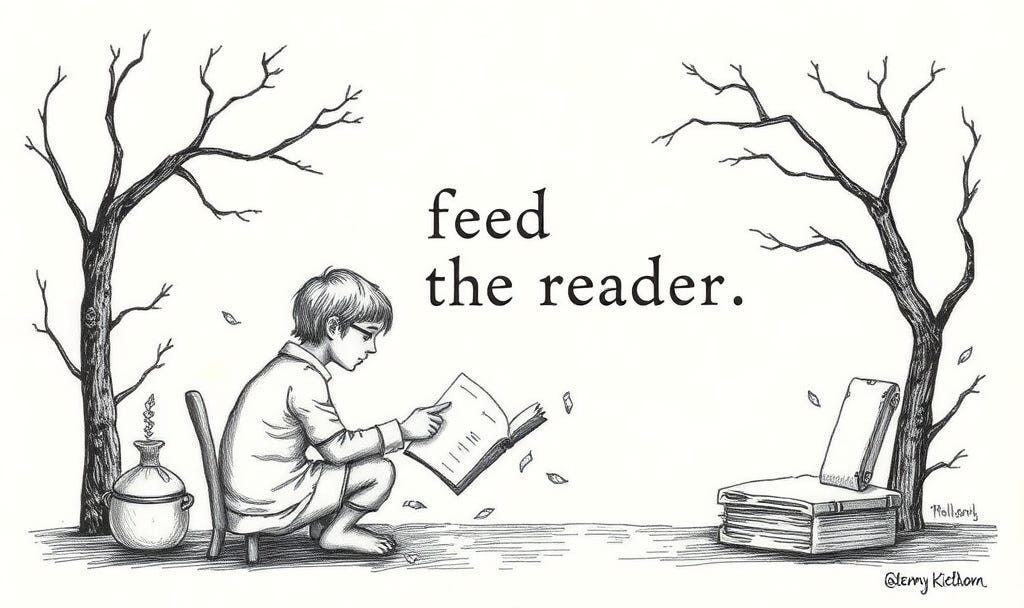
Let’s just say it: content marketing sounds awful. It sounds like something that happens to you in a waiting room. It sounds like the reason you have seventeen browser tabs open about a blender you looked at once.
You’re a writer. You wrote a book. Now someone is telling you to “build your platform” and “create a content strategy,” and you want to lie down on the floor until the feeling passes.
Here’s the thing, though. You don’t have to do any of that.
There was a time when advertising worked. Don Draper could sell you a feeling in sixty seconds flat — nostalgia, aspiration, the vague sense that this cigarette understood you. Beautiful stuff. Completely gone now. The internet killed the long-form ad the way it killed everything else that required patience.
What replaced it? Display ads. The little rectangles that follow you around the internet like a golden retriever who just learned the word “retargeting.” Most authors, desperate to move copies, throw money at Facebook and Amazon. The ads get clicked approximately never. Zuckerberg and Bezos get paid. The book sits there.
Nobody buys a book from an ad. Think about the last book you bought. Did an ad sell it to you? No. Someone you trusted told you about it. You read something that made you want more. You showed up because you were already a fan.
Which brings me to Constance.
Last Sunday, we held a book event. Constance read from her book. Her brother Nick interviewed her about being a violinist, a teacher, and a writer, and how those three things manage to coexist in one person without anyone getting hurt. She sold out. And at the end, people weren’t just buying the book. They were asking when the next one was coming.
That’s not marketing. That’s an audience.
Constance has been writing her Substack consistently for readers who genuinely want to hear from her. She owns that relationship — not through an algorithm that can change its mind on a Tuesday, but through an email list. Her readers are there because they chose to be there. And now the next book? We’re going to build it from her Substack posts. The audience isn’t waiting to be found. They’re already waiting.
You’re a writer. The whole strategy, in its entirety, is this: keep writing.
Write for your readers. Feed them — not in a salesy, look-at-my-book way, but in the way you’d want to be fed. Give them something worth reading. Do it again next week. The readers who connect with your work will find you, stay with you, and show up when it matters.
That’s content marketing. It’s just writing. You already know how to do it.
And now a personal essay
The Characters Are Not Talking to Me
by Liz Dubelman
My day job is cheerleading. Authors finish their books and hand them to me, and I figure out how to make the world care. I read what they’ve written. I can usually see where another edit would have helped. I know which sentences are doing work and which ones are decorating. Then I build the campaign, make the noise, and send the book out into the world.
I’m good at it.
The problem is Abby.
Abby is fifty-eight, recently widowed, living in a retirement community that smells like ambition deferred. She’s discovered a casino bar and a pole dancer named Nicole and the particular freedom of lying to people who would prefer she stay home and attend water aerobics. She’s interesting. She has things to work out. She showed up in my head fully formed, the way the best characters do, and I started writing her down.
Then I got busy with someone else’s book.
Then another book. Then the newsletter. Then someone stole my identity and used it to solicit authors by email, which required its own kind of damage control.
Abby went quiet.
This is the part that’s hard to explain to people who don’t write fiction. The characters don’t wait patiently. They don’t leave a note. They just — stop. You come back to the page and the room is empty and a little cold, and you can feel that they were there recently but aren’t anymore, and you don’t know if they’re gone or just not speaking to you yet.
I think mine are not speaking to me yet. I’m choosing to believe that.
The other problem is that fiction has no guardrails. The newsletter has a job — warn people, explain the scam, be clear. The Feather Act has no job except to be true. No structure to hide behind. No client to serve. Just me, Abby, Nicole, and Bill at the casino bar, and whether I can make them feel like real people without explaining them to death.
I spend my days seeing exactly where fiction fails. I read the books after they’re written, and I can see the seams, the places where the author over-explained or under-trusted or patched something instead of fixing it. That’s not an asset when you sit down to write your own work. It’s a sniper in the room.
So I don’t write. I tell myself I’ll write when I have a longer stretch of time. When the current book wraps. When I’m less tired. Abby sits somewhere just out of reach, not angry exactly, but not warm either.
Here’s what I keep coming back to: the person who impersonated me built something that had all the surface features of care and none of the actual thing. It knew my biography. It used my name. It sounded like someone who’d read your book and thought: yes, this.
That’s what I’m afraid of doing to my own characters. Showing up with the right words and none of the attention.
The attention is the thing. It’s the only thing. You can’t fake it, and you can’t manufacture it between other people’s deadlines, and when you try, the characters know. They go quiet. They wait to see if you mean it.
I’m going back to Abby. Soon. Before she gives up entirely. You can be my witness.
One of your best posts, both parts.
Excellent post. I am fortunate to be working with you. I hope you will soon carve out some time for Abby. She’s kind of a client, too. 😊