

Welcome to the Circus

You became a writer because you had something to say, not because you wanted to cosplay as a marketing executive. But it's 2026, and a brilliant manuscript without a marketing plan is like screaming into a void that's also wearing noise-canceling headphones—technically, you're making sound, but nobody's hearing it.
The publishing world has changed faster than your ability to keep up with it. Remember when authors just wrote and publishers handled the rest? That’s as relevant now as a rotary phone at a startup. Today’s authors need to be part Virginia Woolf, part carnival barker, without losing their minds or selling their souls.
Here’s what nobody tells you: all marketing starts as someone’s creative vision for connecting with people. It’s not evil. It’s just another form of storytelling—one where the story happens to be “why this book matters and who needs to read it.”
This book exists because you need to promote your work without feeling like you’re slowly dying inside. We’ve built The Write Kit—marketing software for writers who’d rather be writing—and this is your manual for using it without wanting to throw your laptop out a window.
We’ve been doing this for twenty years. We know things. We’ve watched authors navigate social media’s rise, the AI revolution, and whatever fresh digital hell awaits us next month. The material here incorporates best practices from authors who’ve actually succeeded at this impossible task of being both artist and salesperson.
The truth nobody wants to hear: finding readers is almost as important as the writing itself. Whether you’re with a traditional publisher or going it alone, you’ll do most of the marketing yourself. This shocks people. But such is the state of publishing—surprise, you’re also in sales now.
It’s not as bad as it sounds. We’ll show you how to promote yourself authentically, in ways that don’t leave you feeling hollow and defeated. You’ll still have energy left for actual writing, which remains the point of all this.
Throughout The Write Kit we include “Sprints”—quick hits of information you can actually use. The goal is simple: help you enjoy using your voice and passion in service of your work. Reaching readers can be fun. Really. We’re not lying. Okay, we’re mostly not lying.
Success means different things to different people. Our definition: making a genuine connection with readers who need your words—whether that’s ten people or ten thousand. You’re giving words to feelings they couldn’t articulate, making them feel less alone. That’s the whole game.
You’ve invested time, money, and creative passion into writing. Marketing should be a natural extension of that investment, though we know you’re skeptical. We hear it constantly: “I was the last person to get a smartphone,” or “Everyone knows more than me,” or “Nobody cares what I have to say.”
Resist this bullshit. You write because you have something to say. People need to hear it. Your art matters. Your voice matters. Your ideas matter, even when it doesn’t feel that way at 3 AM when you’re staring at your manuscript, wondering if you’ve wasted your entire life.
You’re not alone. We’ve built a framework for this—we call it becoming a Whole Artist. Think of yourself as a literary matchmaker, connecting your book with its perfect reader soulmates.
The Write Kit won’t sugarcoat reality: if you want readers, you need marketing. But we’ll make it as painless as possible, like a root canal with really good drugs and a therapist on standby.
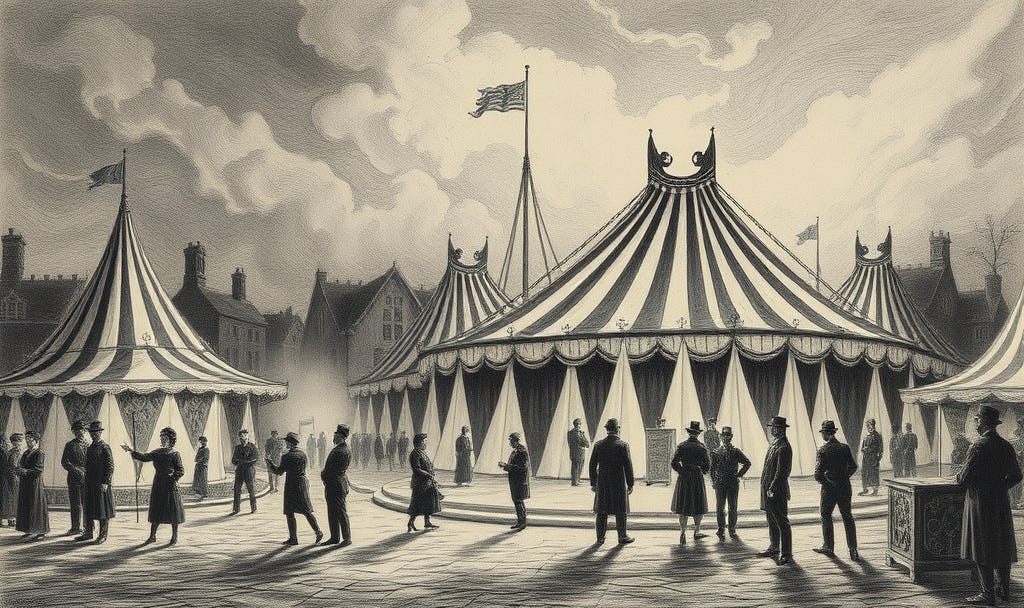
Welcome to the circus. At least the costumes are optional.
A Fiction Break (written in Bonnie Garvin’s class)
500 Words Maximum
by Liz Dubelman
It’s 2:47 AM. I’m filling out an application for a writer’s residency in upstate New York. They offer six weeks, a cabin with heat that actually works, and $2,000 to write whatever I want. The application is twelve pages long, which seems excessive for what amounts to “please let me hide in the woods and pretend I’m Thoreau but with WiFi.”
I’ve sailed through the easy questions. Name: check. Address: the Frank Lloyd Wright cottage that’s currently leaking in three places because Mr. Wright apparently designed it while deeply confused about California’s relationship with rain. Occupation: I stare at this one for a while before typing “Writer” without the apologetic parenthetical I usually add (freelance) (emerging) (unemployed).
Then I hit Question 9: Where do you see yourself in five years? Please describe your artistic and personal goals. (500 words maximum)
Five hundred words. They want my entire future in less space than it takes to describe a decent dinner party.
I pour myself two fingers of Jameson’s—the good stuff I’ve been saving for when I actually sell something, but fuck it, it’s almost 3 AM, and I’m applying to live in a cabin like some kind of literary hermit who peaked in the 1840s. The whiskey tastes like liquid campfire, which feels appropriate for someone about to set her life on fire in three different ways.
I start typing the acceptable answer. The one they want to hear:
Draft 1: The Lie
In five years, I see myself as an established voice in contemporary fiction, building on the foundation of this residency to complete my novel about...
I stop. Delete. This is bullshit and we both know it. They’ve read this same answer from 400 other writers who are also pretending they have a plan, that they’re not just desperately trying to buy six weeks where nobody asks them why they’re not being more practical.
Let me try again. The honest version. The one where I admit what I’m actually afraid of:
Draft 2: The Truth (The Bad One)
In five years, I see myself...
My daughter calls from her room. “Mom? I can’t sleep.”
“Me neither, baby. Count backwards from a hundred.”
“That doesn’t work.”
“Try prime numbers. They’re harder.” This is how I’ve fucked her up—teaching her to use mathematics as a sleep aid like some kind of Beautiful Mind situation but with more anxiety and less genius.
She pads back to bed, and I return to the cursor, blinking at me like it knows I’m a fraud.
Draft 2: The Truth (The Bad One)
In five years, I see myself living with my sister, the successful copyright attorney in Century City, sleeping on her Danish modern couch that cost more than three months of my current rent. I will have taken a job doing social media management for someone’s overpriced candle company or artisanal dog treat business—something that makes me want to drive into the ocean every morning but pays for my daughter’s private school because the custody agreement stipulates she maintains her “current standard of living.” I will have stopped writing because exhaustion killed whatever romantic notions I had about art requiring sacrifice. The stories will pile up in my head like those credit card bills I keep meaning to deal with. I’ll tell myself it’s temporary, just until I get back on my feet, but temporary has a way of calcifying into permanent when you’re too tired to remember who you used to be. My ex-husband will feel vindicated. That’s the part that keeps me up at night—not the poverty or the fear, but knowing Richard was right when he told the judge I was “fundamentally incapable of providing stability.” I will survive this, because that’s what I do. I’m good at surviving. My Holocaust relatives made sure survival was coded into my DNA like some kind of genetic PTSD. But I won’t recognize myself. I’ll be the kind of person who sees other people taking risks and feels that hot spike of resentment that means you’ve given up.
I read this back and feel the walls of the cottage closing in. The cursor blinks. Five hundred words maximum, they said. I’m at 247 and I’ve already made myself want to drink the rest of the Jameson’s and possibly the Rose’s lime juice from the Clinton administration.
My phone lights up. A text from my ex: Need to discuss summer custody schedule. Also saw you were up—are you job hunting or just indulging your insomnia?
It’s like he has a sensor for my moments of maximum vulnerability. I don’t respond. Instead, I pour another finger of whiskey and realize I’ve been approaching this all wrong.
What if I stopped pretending? What if I wrote the answer I’d give if I didn’t give a single fuck about what they think, what Richard thinks, what the custody evaluator thinks, what anyone thinks?
Draft 3: The Truth (The Real One)
In five years, I see myself in Portugal. Lisbon, specifically, because I read somewhere that writers can live cheap there and the light is supposed to be incredible. I don’t speak Portuguese. I don’t even speak Italian despite that time I pretended to read Italian Vogue to avoid talking to my then-husband. But I’ll figure it out the way I’ve figured out everything else—badly at first, then competently, then with a kind of feral confidence that scares people who’ve never had to improvise their entire lives.
I will sublet this leaking Frank Lloyd Wright cottage to someone who thinks cold houses are romantic and architectural pedigree matters more than functional windows. I will homeschool my daughter in cafés where nobody knows I’m supposed to be sensible. We’ll eat Portuguese custard tarts for breakfast, and she’ll learn that safety nets are a luxury we can’t afford, but adventure is free if you’re brave enough to be bad at things.
Maybe I’ll write that novel about party planning during national trauma—the one about the woman trying to orchestrate a celebration for moon landings while Los Angeles bleeds and her daughter can’t sleep because someone’s at the door. Maybe it becomes something. Maybe it doesn’t. Maybe I stop writing altogether and open a tiny restaurant that only serves the elaborate meals I make at 3 AM when I’m bored and anxious. It’ll be the kind of place Anthony Bourdain would have loved before he died—weird hours, no menu, just whatever I felt like cooking that day.
I’ll have affairs with inappropriate people and not feel guilty because guilt is for people who stayed in New Jersey when they could have left. I’ll collect stories instead of mismatched stemware. I’ll stop explaining myself to therapists, ex-husbands, custody judges, and grant committees. I’ll become the person my Holocaust relatives would have been if they’d had the luxury of wildness instead of just survival.
I’ll fail spectacularly at several things. I’ll succeed unexpectedly at others. Most importantly: I’ll stop asking permission to want what I want.
I sit back. Read it again. It’s 3:23 AM now and I’ve written myself into three completely different futures, none of which involve this residency in upstate New York.
The application has a text box that says “500 words maximum” but doesn’t specify which 500 words. Which version of my future fits in their character limit? Which one do they want to fund?
My daughter appears in the doorway, dragging her blanket. “Mom, I had a bad dream.”
“About what?”
“That you went away and didn’t come back.”
I close the laptop. “Come here, baby.”
She climbs into my lap—she’s getting too big for this but neither of us cares—and I can smell her kid shampoo and feel her heart beating against my chest. This, I think, is the only future that matters. Not the one where I’m careful or successful or validated by a grant committee. The one where she knows I came back.
“I’m not going anywhere,” I tell her, which is either a promise or a lie depending on which draft I submit.
“Can we have pancakes?”
It’s 3:30 in the morning. We have no eggs, and the only milk in the fridge expired on Tuesday. But I’ve always been good at improvising.
“Yeah, baby. We can have pancakes.”
I’ll finish the application later. Or I won’t. Right now, there’s a six-year-old who needs to know her mother can make something out of nothing, which is basically the only skill that matters for any of these futures anyway.
Libraries do not require a traditional named publisher. They require availability through distributors. Ingram alone serves over 39,000 libraries and retailers worldwide. If a book is in that system, libraries can—and do—buy it.
The same is true for sales. Books sell because of distribution, metadata, pricing, and demand—not because of a logo on the spine. Independent and hybrid titles sell every day through libraries, bookstores, online retailers, and institutions. Happy to discuss. Thank you, Liz
Without a larger publisher, it's hard to sell books. You lose library sales, which is half. Then you lose name publisher sales, which is the other half. That leaves... well, you do the math : )