

All of the Above

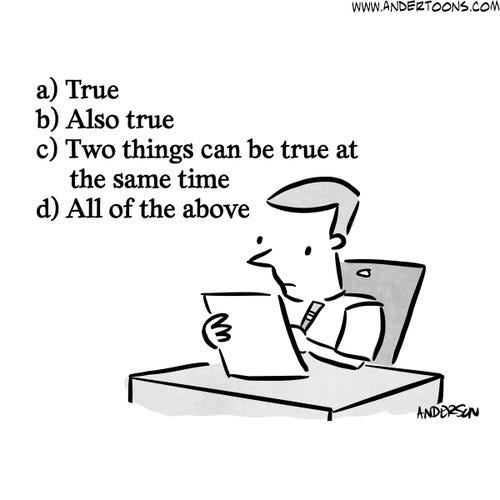
There’s a question people ask at parties, on first dates, and in the opening minutes of every networking event that has ever made me want to hide behind the cheese plate:
“So, what do you do?”
The honest answer — the real, full, complicated answer — is: so many things that I’m not sure where to start.
I’m a writer. I’m also an entrepreneur. A mother. A wife. An artist. A book coach. A marketer. A teacher. Depending on the day, I am also chief snack procurer, amateur therapist, and person who googles things at 11 p.m. that no single job title would explain.
And for a long time, I felt like I was supposed to pick one. To get my story straight. To sand down all the interesting edges and hand someone a clean, laminated version of myself.
I’m done with that. And I think you should be, too.
The One-Sentence Trap
We’ve been conditioned to believe that a person who does many things is somehow less credible than a person who does one thing very loudly.
This is not true. It is, in fact, the opposite of true.
The most interesting people I know — the ones doing the most meaningful work — are always a combination. The therapist who is also a fiction writer. The chef who is also a community organizer. The teacher who is also a painter. The entrepreneur who is also a mother, which means she is also a project manager, a mediator, a nurse, and someone who can find literally anything in the house.
The multitudes aren’t a liability. They’re the whole point.
Your life’s experience — every role you play, every skill you’ve built, every hat you’ve worn until it was frayed — is what makes your perspective yours. It’s what makes your work irreplaceable. Nobody else has your exact combination. That’s not a mess. That’s a mosaic.
The False Choice We’ve Been Sold
For generations, we were handed a binary: be focused or be scattered. Be professional or be complicated. Pick your lane.
But identity doesn’t work in lanes. It works in layers.
You are not a writer instead of a mother. You are a writer who is also a mother, and those two things talk to each other constantly in ways that make your writing richer and your mothering stranger and more tender and more patient and occasionally more dramatic.
You are not a marketer instead of an artist. You are an artist who understands how stories move through the world — which means your marketing has a heartbeat that other people’s marketing doesn’t.
The roles don’t cancel each other out. They compound.
How to Present Yourself as All of It
Here’s the practical question I get asked constantly: But how do I explain all of this to people? How do I present myself without sounding scattered?
The answer is simpler than you think, and it has nothing to do with a tidy elevator pitch.
Find the thread.
Every combination of roles has a through-line — a single thing that all of your work is actually about, underneath the job titles. Not what you do, but what you care about. What you’re always, in every version of your life, trying to move toward.
For me, that thread is: helping creative people take themselves seriously.
That’s what I’m doing when I’m coaching a writer through their first draft, when I’m teaching a class on marketing, when I’m writing about what it means to build a creative life alongside a real life with real people in it, when I’m mothering someone who is also, I notice, becoming a creative person of their own.
All of it is the same conversation. The titles are just the different rooms it happens in.
Lead with the work, not the résumé.
When you introduce yourself, you don’t need to list everything. You need to show someone what it feels like to be in your orbit. That’s what people actually want to know — not your LinkedIn summary, but your essence.
“I write about the creative life — and I help writers actually finish things and get them into the world” is more useful than a seven-item list of everything you’ve ever done professionally. It’s not less true. It’s more you.
Stop apologizing for the complexity.
You know that thing you do where you say, “I’m just a mom who also writes a little,” or “I’m kind of a marketer, I guess, but I’m also doing coaching and some teaching”?
Stop it.
The hedging doesn’t make you sound humble. It makes you sound like you don’t believe your own story — and if you don’t believe it, no one else will either.
Own the compound noun. You’re a writer-entrepreneur-teacher-mother-artist. Say it like it’s a credential, because it is.
A Permission Slip
You are allowed to be many things. You are allowed to resist the flattening. You are allowed to answer the “what do you do?” question in a way that is true and a little complicated and takes more than five seconds.
You are allowed to introduce yourself as a whole person — not a job description.
The people who are meant to find you will find you. Not because you made yourself simple enough to fit inside a box, but because you were brave enough to let them see the whole mosaic.
That’s not a harder sell.
That’s a richer story.
And you, of all people, know what a good story can do.
What’s your through-line? I’d love to hear it — drop it in the comments.
A Fiction Break (WIP)
The Digital Daughter
By Liz Dubelman
Time keeps speeding up. More things are invented, and I can’t keep up.
My children hired me a digital daughter. She comes on Tuesdays. She has good posture and a kind face, and she never sighs, which I appreciate. She sets her phone on my kitchen table like a doctor setting down a bag, and we begin.
It’s not unlike home ec.
In 1955, I was fifteen and all the girls took home ec while the boys took shop. The boys built things with their hands. We learned to clean what they would eventually dirty. Mrs. Newell taught us the chemistry of cleaning solutions, which I have since forgotten except for one thing: do not mix chlorine bleach with acid or you will make chlorine gas, which is toxic. I don’t know how I held onto that and nothing else. I still think about it when I reach under the sink.
The digital daughter shows me how to swipe. How to double-tap. The difference between a push and a swipe, she explains, is subtle. My fingers don’t always register on the glass. I don’t mention this. She wouldn’t know what to do with it, and neither would I.
She asks if I have any questions.
I want to ask her if she knows what home ec was. I don’t ask.
Mrs. Newell wore her hair pinned so tightly it seemed to be holding her opinions in place. She believed in systems. She wrote on the blackboard in a hand so exact it looked typeset.
Home cleaning tasks can be separated into four categories.
We copied this down. All of us girls, in a row, copying. Through the wall, we could hear the boys in shop running something electric. A saw, maybe. Something that made a sound like purpose.
Mrs. Newell taught us that hard water deposits require acid solutions and grease requires alkaline solutions and that the two should never meet. She taught us that chlorine bleach mixed with strong acid produces chlorine gas, which is toxic. She said toxic the way other people said obviously. She taught us that even dishwater, under certain circumstances, required rubber gloves.
I sat in the third row next to Barbara Feinstein, who would go on to become a pharmacist and probably retained all of it. I retained the chlorine gas. I don’t know why that one stayed, and nothing else did. Some specific terror lodges itself, and everything around it slides away.
We were being prepared for our lives.
None of us knew yet what our lives would be.
The digital daughter’s name is Melissa. She’s thirty-two, she told me, which means she was born the year I got my first answering machine and thought that was already too much.
She’s teaching me to video call my grandchildren. She says it’s really very simple, the way Mrs. Newell said, obviously. Neither of them is wrong, exactly. That’s the problem.
Melissa shows me how to find the camera icon. I find it. I lose it. I find it again. My finger pushes the glass, and nothing happens, and then I push it again and something happens that I didn’t intend. Melissa says that’s okay without looking up from her own phone, where she is, I notice, also doing something. I don’t ask what.
I think about the boys in shop. Whatever they built, they could see it. A birdhouse. A bookshelf. Something with edges you could run your hand along and know you’d done it.
I push the glass again. A face appears. My granddaughter, eleven, looks at me from whatever room she’s in and says Hi Grandma and then looks back down at something I can’t see.
We have that in common, at least.
Melissa packs up on the hour. She’s very good about the hour. She puts her phone in her bag and tells me I did great today, which is what she always says, and I think she means it, which is its own kind of thing.
After she leaves, I sit at the kitchen table for a while.
I can video call my grandchildren now. I could not have done this two months ago. Whether this is progress depends on who you ask. My granddaughter looked at her phone the entire time.
I reach under the sink for the dish soap, and I automatically check the labels before I touch anything else. I have done this for sixty years. Mrs. Newell would be pleased, probably. One student retained one thing. Maybe that’s enough. Maybe that’s all anyone gets.
I don’t know what Melissa thinks I’ll do with any of this. I don’t know what Mrs. Newell thought either. They’re both just women doing a job someone decided needed doing.
Time keeps speeding up.
I washed the dishes without rubber gloves. The water was hot, and it felt like something I still knew how to do.
Now that I'm no longer in the workforce, I feel like I need to rethink my answer other than saying, "Retired educator."
One of my best ones was "I teach ethics to medical students". It wasn't all I did but gave enough scope for multiple conversations and opinions. So give enough to pique the questioner's curiosity. If that is genuine, it works. if not, you are forced to repeat the question to them and that usually falls flat. A good reason to move on when it is polite to so do.